|
3D modelling of polycrystalline substructure development, with particular emphasis on ice and NaCl Name: Paul D. Bons - Prof. Dr., C3-Professor Structural Geology Born 20 February 1964 in Sydney (Australia) Nationality: Netherlands & Australia Address: Mineralogy and Geodynamics, Institute for Geosciences Eberhard Karls University Tübingen, Sigwartstraße 10, 72076 Tübingen, Germany Tel, 07071/2976469, Fax, 07071/5059, E-mail,
This e-mail address is being protected from spam bots, you need JavaScript enabled to view it
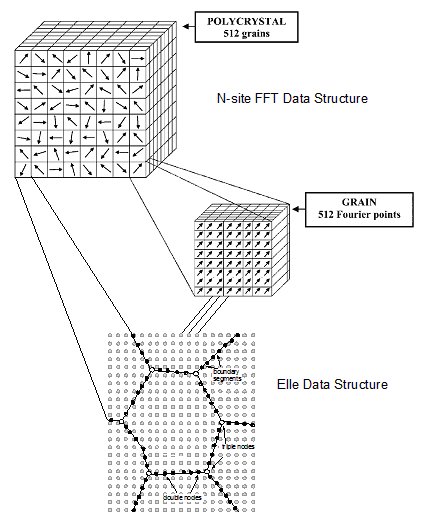
aims & objectives Numerical modelling currently plays an indispensable role in our scientific pursuit to predict, understand and interpret complex systems, such as (sub-) structure in polycrystalline systems. Contrary to experimental methods, numerical modelling is unhindered by time- and length-scale constraints (within the limits of ever increasing computational capabilities). Numerical models can thus be developed based on theory, be tested and validated with experiments and then applied to systems that are beyond the scope of experiments, such as the flow of glaciers or the creeping of salt in diapirs. The objective of this IP is to numerical model the substructure development of polycrystalline mineral aggregates (especially ice and NaCl) with particular emphasis on the progressive development of subgrains, from their initial nucleation to maturation as proper grains with high angle boundaries. Ice and halite (NaCl) are both minerals that occur in large mono-mineralic volumes in nature: salt layers/domes/diapers, and glaciers/polar icecaps, respectively. Both systems are of direct importance to human society. Salt diapirs are potential hosts for nuclear waste and salt layers are important as hydrocarbon seals in the oil and gas industry. Understanding the mechanical properties of ice in glaciers and icecaps is of paramount importance in a time of changing climate. Furthermore, icecaps store a long climatic record. Unravelling this climatic record necessitates understanding of the crystalline processes that affect the progressively buried ice layers and the climatic signal stored in them. Ice and halite are ideal for the current IP as they represent two distinct types of minerals: halite is a cubic mineral with multiple slip planes at its disposal for dislocation creep, whereas ice is strongly anisotropic with effectively only one slip system. Furthermore, halite is a highly soluble mineral, deforming by the additional mechanism of dissolution-precipitation creep in the presence of brine. This IP will implement and run simulations of substructure evolution as a result of the coupling of subgrain nucleation and maturation, grain boundary migration, crystal plastic deformation and/or dissolution-precipitation creep. The simulations serve two objectives: a. To bring understanding and insight in the substructure development as a result of interacting, coupled multi-scale processes that act in a polycrystalline material as a result of the applied boundary conditions and the specific material properties, allowing the prediction of the material behaviour and properties under conditions and scales away from experimental ones. b. To better interpret observations and measurements made on natural mineral aggregates, in terms of the processes, conditions and boundary conditions that led to the observed substructures. Indicative statistical (e.g. grain size distribution) and topological/morphological (e.g. grain shape) parameters need to be defined with the help of the simulations. The above objectives will be reached with the numerical modelling platform "Elle" (Jessell et al. 2001). It provides a versatile framework in which the various individual processes can be modelled. However, several of the currently available modules in Elle are currently 2-dimensional only. Although this is permissible in many respects, it is insufficient to model all aspects of recrystallisation, and particularly to determine the resulting statistical and topological parameters. The latter is of utmost importance to compare the numerical simulations with natural data sets, which are inherently 3-dimensional (although often analysed in 2D section, see fig. 1). Therefore, this IP will expand the relevant modules in Elle from 2 to 3-dimensional. The modelling will be applied to and compared with datasets from natural ice and halite: Ice: The current collaboration with the Alfred Wegener Institute (AWI), Bremerhaven, Germany, where the applicant co-supervises a PhD-student I. Hamann, provides direct access to a comprehensive series of thin sections from Antarctic drillings, with samples taken at regular intervals down to >2 km depth. Questions to be addressed are: - What deformation mechanisms and recrystallisation processes operate as a function of depth?
- How can the amount of recrystallisation be quantified to determine the amount of climatic signal modification (blurring, shifts)?
- How does the climatic signal (especially climatically and seasonally modified dust content) influence substructure development and rheology of ice?
Halite: The team in Aachen hosts an extensive collection of halite samples (some radiated) from a variety of settings and origins (Netherlands, Germany, Oman). Specific questions to address are: - What is the specific effect of wetted grain boundaries on substructure development in halite?
- What controls the particular form of exaggerated grain growth in halite?
- How does substructure of halite influence the rheology of halite? Here the aim is to develop improved rheological models for the deformation of halite, which include the substructure as a parameter, of relevance to model of halite flow in oil seals and in temperature gradients resulting from nuclear waste storage.
|