|
In-situ deformation of MgO and Fosterite at high temperatures Professor Dave Prior Department of Earth and Ocean Sciences University of Liverpool L693GP, UK. Telephone: +44 (0)151 794 5193 Fax: +44 (0)151 794 5193 Email
This e-mail address is being protected from spam bots, you need JavaScript enabled to view it
Aims and Objectives
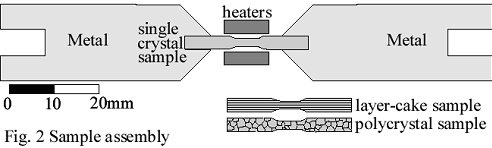
We aim to document the kinematics of intracrystalline substructure development and the way these substructures interact with intergranular boundaries, during high-temperature deformation experiments of MgO and forsterite. Time-series measurements of substructures, as they develop, provide a rigorous observational database against which to test conceptual, analytical and numerical models of mineral deformation and recovery. Deformation and annealing experiments using transparent analogues 1-3 have provided a guiding framework for understanding frozen-in rock microstructures. More recently the technology has been developed to make observations in-situ in a scanning electron microscope (SEM) using metal samples 4-8. Electron backscatter diffraction (EBSD) was first developed in the 1980s 9 based on earlier observations 10. EBSD enables the individual crystallographic orientations of sub-micron areas of a sample surface to be measured; the 1990s and 2000s saw the EBSD technique become a rapid, automated, quantitative microstructural mapping method 11-14. In-situ SEM with time-series analysis from EBSD allows microstructural evolution to be quantified 15-22. The only in-situ SEM studies of a mineral have been of NaCl 21, 22, primarily because the temperatures needed to activate intracrystalline an intercrystalline processes, such as recovery and recrystallization, in most minerals are high. Temperatures for in-situ analysis have now been pushed to over 1000°C 15, 16, 23 and now we are in a position to conduct in-situ experiments using a wider range of minerals. A limitation that cannot be overcome, in in-situ SEM experiments, is the requirement for low pressure. Some minerals will break-down on heating at low pressure, at temperatures lower than the temperatures needed to activate processes such as recovery in a short-term (<24 hour) experiment. In other minerals (quartz for example), grain boundary mobility is significantly reduced at low pressure. MgO and forsterite are excellent materials for low pressure experiments and we are now in a position to access the temperatures (up to 1400°C) needed to conduct experiments on these materials. Forsterite is clearly more relevant to the Earth, but it is difficult and expensive to fabricate samples. MgO will allow us to explore experimental protocols, and to make mistakes, at less cost. MgO experiments will nevertheless provide good analogue information and can be linked to models more easily as MgO structure and chemistry is simpler. The specific objectives of this IP are: 1) To develop experimental protocols to conduct high temperature deformation experiments, using MgO and forsterite mineral samples, in-situ in a scanning electron microscope. 2) To deform single crystal samples (MgO and forsterite) in-situ at a range of temperatures between 1100°C and 1400°C to constrain how substructure develops. 3) To deform layer-cake (MgO) samples at a range of temperatures between 1100°C and 1400°C to constrain how substructure develops and interacts with boundaries in a configuration that is relatively easy to relate to 2D numerical models. 4) To deform polycrystalline samples (MgO and forsterite) at a range of temperatures between 1100°C and 1400°C to constrain how substructure develops and interacts with boundaries in samples that represent real rock microstructures.
|