|
Development of new substructure-based micro-gauges for the interpretation of deformation microstructures.
Prof. C. J. Spiers, HPT Laboratory, Department of Earth Sciences, Utrecht University, Postbus 80021, 3508 TA Utrecht, NETHERLANDS,
This e-mail address is being protected from spam bots, you need JavaScript enabled to view it
, Tel: +31 30 253 4972, Fax: +31 30253 7725
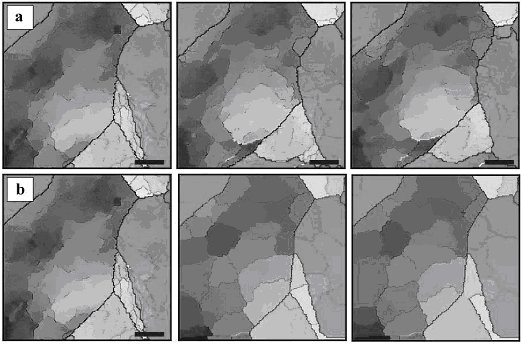
Project overview The primary objective of this proposal, in collaboration with Dr M.R. Drury, is to develop new gauges based on microstructural measurements derived from electron backscattered diffraction (EBSD) mapping. The gauges should correlate microstructural parameters such as subgrain size, misorientationof within and between subgrains to dislocation creep strain, quantify strain partitioning in multi-mechanism flow and define grain size in terms of properties that control mechanical behaviour during flow, such as the diffusivity and sliding resistance. Furthermore, the gauges should be applicable to the diverse and inhomogeneous microstructures often found in geological materials. The partitioned strain estimates and grain sizes will be used to improve constitutive equations that model Earth rheology. We propose investigating and testing new microstructural gauges to quantify strain partitioning during multi-mechanism flow. Using EBSD to study subgrains in NaCl, we have found that the average misorientation of subgrains boundaries and the orientation gradient within grains may be useful gauges for the amount of strain accommodated by crystal plastic deformation. Furthermore, a power law relationship exists between average misorientation of subgrain boundaries and strain. Further experimental work is needed to establish the range of strain over which the power law relationship operates. This relationship could be used to estimate strain partitioning and to improve the constraints on constitutive (rheological) equations for multi-mechanism flow. We also propose developing the new concept that the (sub)grain boundary hierarchy may be useful in determining the mechanically significant grain size and grain size distribution. Our studies on NaCl suggest that grain size reduction during deformation, caused by the rotation of subgrain boundaries to high angle misorientations, may not be sufficient to cause weakening at high strains. High strain deformation experiments are needed to determine which of the boundaries that are produced during deformation, in terms of their diffusion and sliding properties, influence flow, and whether sufficient reduction of the mechanically significant grain size occurs to cause weakening.
|